


|
||
|
|
||
|
||
|
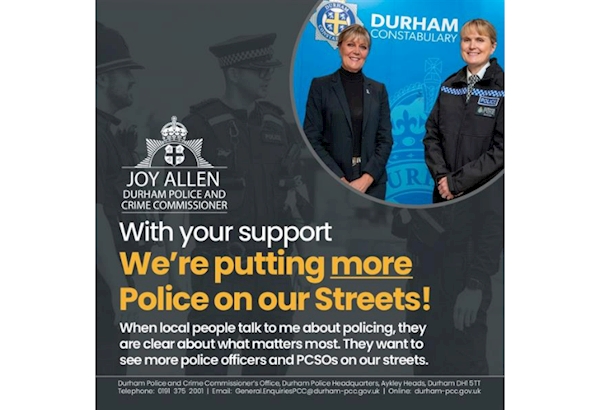
A message from Durham Police and Crime Commissioner... We’re Putting More Police on your Streets. |
||
|
When local people talk to me about policing, they are clear about what matters most. They want to see more police officers and PCSOs on our streets, and firm action against the crimes that cause the greatest harm. That message came through strongly in the recent policing precept consultation. Visible neighbourhood policing was your top priority. Tackling serious violence and drug-related crime followed closely behind. Your priorities guide every decision I take, and they also guide the Chief Constable’s operational response. Since I was first elected as PCC in 2021, I have been relentless in lobbying government to rebuild policing in County Durham and Darlington. Under the previous Conservative government, our area lost 27% of its police officers — more than 400 fewer boots on the ground. County Durham and Darlington is now one of just 9 forces out of 43 in England and Wales that still has fewer officers than it did in 2010. That is not because demand here is lower. It is because our low council tax base limits how much can be raised locally to invest in policing. That is why I welcomed the decision by this Labour government to grant Durham exceptional flexibility on the police precept which gives us the ability to raise additional funding locally to protect and grow our policing service. When the Chief Constable presented her operational plans to the Police and Crime Panel, she was clear that setting the precept at £18.50 rather than £15 would allow us to deliver exactly what residents have asked for. That included protecting neighbourhood policing and establishing a dedicated Criminal Exploitation Team to tackle drug-related crime and the exploitation of children and young adults, dismantle drug networks and disrupt those who profit from harm. It will also enable dedicated resources to tackle antisocial behaviour linked to child exploitation and children who go missing from home, and to increase specialist investigators so we can build a future dedicated team to investigate rape and sexual assault and deliver a first-class service to victims. The additional cost would have been modest. For a Band D household, it amounts to 36p a week. For the vast majority of households in County Durham and Darlington around 80 per cent in Bands A and B, it is around 24p week. Despite this clear alignment between public priorities and professional advice, I was disappointed that the Vice Chair of the Police and Crime Panel, a Reform councillor and former police officer, proposed that the additional precept proposal was vetoed and the Chair, also a former police officer, used his casting vote against the additional £3.50 flexibility the Chief Constable needed to deliver her plans. As your Police and Crime Commissioner, I am elected by local people to set the policing budget and deliver your priorities. I have therefore agreed to set the precept at £18.50, because failing to do so would have meant avoidable cuts to policing capability and turning my back on the priorities residents have consistently set. This episode should also give us pause for thought. It shows what can happen when councillors without a direct mandate for policing seek to override operational policing advice and public priorities. As national debates continue about police governance and the future of PCCs, we should be honest about the risks of moving to models where accountability is diluted. Until then I will continue to deliver what matters to you: more police on our streets, stronger action against serious harm, and a policing service that puts victims and communities first.
| ||
Reply to this message | ||
|


|